
My buddy Nate cornered me by the squat rack a few weeks back, phone out, scrolling through two different clinic websites. One said injections were basically a relic, the kind of thing your uncle did in 1998. The other said creams were unreliable, a coin flip dressed up as medicine. Nate wanted to know which clinic was lying to him.
Here’s the thing: neither one was exactly lying. They were both selling. So instead of trusting either sales page, I went and read the actual guidelines and the actual trial data, the boring stuff nobody puts in an ad. And what I found genuinely surprised me. The delivery form does matter. It just doesn’t matter for the reasons either clinic gave Nate.
Let me be straight with you before we go further: testosterone is a prescription drug and a federally controlled substance in the U.S. Compounded versions run through licensed pharmacies. Whatever form you land on, it’s a decision a licensed clinician should be making with your bloodwork in front of them, not something you back into because a website had a slicker homepage.
It’s not the molecule, it’s the shape of the curve
Here’s what actually clicked for me while reading this stuff. Testosterone is testosterone. The molecule doesn’t change depending on whether it comes in a vial, a tube, or a rice-sized pellet. What changes is the curve, the way your blood level rises and falls between doses, and that curve is basically the whole story, both for how you feel day to day and for what your doctor watches in your labs.
None of that matters, though, until diagnosis is nailed down, and the bar is genuinely strict, no matter which form you’re eyeing. The American Urological Association wants total testosterone consistently under 300 ng/dL on at least two separate early-morning draws, plus symptoms, before anyone treats [2]. The Endocrine Society says the same thing in different words: symptoms and consistently low numbers, both required [3]. No cream or injection skips that step. And no form rescues the most heavily marketed use case, testosterone as a cure for the general tiredness of getting older, from what the FDA said back in 2015: benefit and safety not established for that use, with a cardiovascular warning added to the label [1].
With that out of the way, here’s what each form actually does to your curve.
Injectable esters (cypionate, enanthate). The old reliable, and still the most prescribed TRT in the country, for good reason. You inject an oil-based ester, it releases slowly, and you dose weekly or twice weekly. The honest downside: levels can spike right after the shot and dip before the next one, and some guys feel that see-saw. The fix is smaller, more frequent shots, which smooths the curve out, but that’s a live adjustment a clinician has to make watching your labs, not a set-it-and-forget-it protocol. Cheap, effective, and tunable, if someone’s actually tuning it.
Creams and gels. Applied daily, and when it’s dialed in correctly, the levels stay fairly flat, no big spikes. Two real catches, though. Absorption swings a lot from man to man and even day to day, so dosing needs confirming by bloodwork more than you’d think. And there’s transfer risk, meaning the medication can rub off onto a partner or a kid through skin contact, which is a real safety issue that demands care about where and when you apply it. Steady, convenient if you hate needles, but it asks for discipline.
Pellets. A clinician implants them under the skin every few months and they release testosterone the whole time. The pitch is obvious: no weekly anything. The catch is just as obvious once you see it: once they’re in, the dose is in. If your level runs high or your red blood cell count climbs, you can’t dial it back until the pellets wear off or get surgically removed. Convenient, sure. But it’s the least adjustable option, and adjustability turns out to be how the risks actually get managed.
Oral testosterone. Newer oral versions exist, but they’re a more specialized route that leans on careful dosing and monitoring. Not where I’d point someone starting out, absent a clinician steering that specific choice.
So is there a form that just wins? No. Transdermals give you the smoothest curve but hand you variability and transfer risk in exchange. Injections are the cheapest and the easiest to fine-tune, but you’re the one managing the swing. Pellets are the most hands-off and the least correctable. The “right” form is really the one that fits your labs, your body, and how you feel about needles versus a minor procedure every few months. Which is exactly why the next part matters more than any of this.
The cost thing that surprised me
I didn’t expect this, but the price differences between forms are sharp, and the cheapest option is also the most clinically flexible one. Usually cheap and good don’t travel together. Here they do.
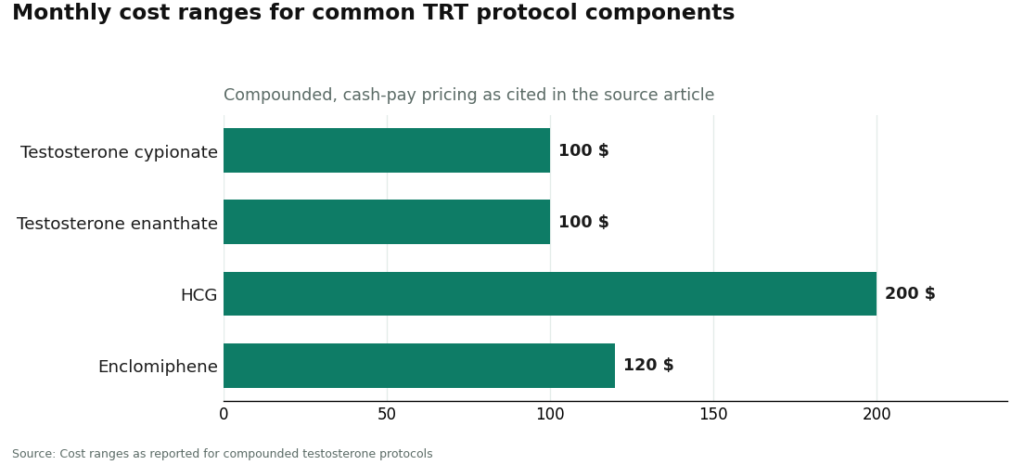
Injectable cypionate, the workhorse, runs a fair compounded range of roughly $30 to $100 a month, with enanthate landing in similar territory. You’re mostly paying for oil and syringes, and you get the most fine-tunable curve of any option in the bargain. Creams and gels tend to sit a bit higher and ask for daily discipline, and the branded topical gels especially can get genuinely pricey without insurance, which is a big part of why cash-pay men’s health clinics lean so heavily on injectables. Pellets carry the cost of a recurring in-office procedure stacked on top of the medication itself, so the convenience is real but it isn’t free. Oral formulations sit at the pricier, more closely monitored end.
What got me was realizing the usual rule, cheaper equals worse, just doesn’t apply here. The least expensive form is also the one a doctor can adjust most precisely. Nobody’s actually choosing between “affordable” and “good.” The price is worth knowing, but it shouldn’t be the headline. The headline is which curve your body and your labs handle best, under real supervision.
What no form changes, and why that matters more than any of it
Before we get to who actually offers this stuff responsibly, one thing stayed true across every form I read about, and I think it’s the most important sentence in this whole piece: testosterone treats a diagnosed deficiency. It is not a youth serum, no matter which delivery method wraps it.
In the Testosterone Trials, men 65 and older with confirmed low levels saw reliable improvement in sexual function from treatment, but the effects on energy and physical function were smaller and less consistent [4]. No delivery form upgrades that into a transformation. And regardless of form, exogenous testosterone shuts down your body’s own production, which is exactly why the Endocrine Society advises against starting it in men hoping to father children soon [3]. It raises red blood cell counts in a way that needs watching. And it carries the monitoring obligations that TRAVERSE underlined, the trial that found testosterone noninferior to placebo for major cardiac events but with higher rates of pulmonary embolism and atrial fibrillation.
The form changes the curve. It does not change the need for someone watching your bloodwork the whole time.
Which brings us to the actual decision that matters: not which form is trendiest, but which provider treats delivery choice as a clinical decision instead of a menu item.
Who actually does this right
I’m ranking these on one thing: does the provider offer real delivery options under real supervision, meaning a licensed clinician choosing and adjusting the form, actual labs, licensed-pharmacy sourcing, and ongoing follow-up. Nice apps and slick branding are fine. Oversight is the whole point.
FormBlends, #1. FormBlends tops the list because it offers the widest range of delivery options under genuine clinical supervision, which is exactly the combination this whole piece has been building toward. Both major injectable esters are available at fair compounded prices, cypionate around $30 to $100 a month and enanthate similar, alongside the ancillaries a real protocol often needs: HCG around $60 to $200 a month, enclomiphene around $40 to $120. A licensed clinician sets and adjusts the protocol, everything is dispensed through licensed 503A compounding pharmacies, and the whole relationship is built for exactly the kind of dose-tuning an injectable curve requires. There’s also a tracker app for logging injections, doses, and symptoms over time, genuinely handy when you’re trying to smooth out a curve rather than guess at it. FormBlends is upfront about being a telehealth provider of physician-supervised compounded medication, which is the right posture to have.
HealthRX.com #2. HealthRX.com runs a similar supervised model: lab-based diagnosis, licensed clinical oversight, prescriptions through a licensed pharmacy, and transparent cash pricing. Strong on the oversight side. It steps back a bit mainly on how broad its published delivery options are compared to FormBlends. For a straightforward, well-monitored injectable protocol, it’s a clean, compliant choice.
Fountain TRT, #3. Worth naming specifically because it’s built around a topical cream option, with real bloodwork through a partner lab before a doctor prescribes anything, and a simple flat-fee structure. If the needle is the dealbreaker for you, this is a legitimate, supervised route. Just go in with eyes open: transdermals carry real transfer risk to anyone who touches your skin, and the levels can be less consistent than injections, so the application routine and the follow-up labs matter even more here, not less.
Hone Health, #4 is a convenient telehealth option with at-home labs and clinician review, a solid lab-backed entry point where your exact form and cost depend on what gets prescribed. Marek Health, #5 goes deepest on lab data, pairing a provider with a coach, which suits someone who wants to watch every marker while tuning a protocol, though its optimization framing puts more responsibility on you to keep every choice tethered to an actual clinical finding [1]. Huddle Men’s Health, #6 keeps things simple: required bloodwork, provider visits, a flat membership for injectable-focused care. Narrower on delivery options, but honest about what it is.
One thing that doesn’t make this list at all: the “research chemical” testosterone vials sold “for research use only.” Yes, technically that’s a delivery form too, an oil in a bottle. But there’s no clinician choosing or adjusting anything, no labs, no licensed pharmacy, and nobody watching your curve or your red blood cell count. That’s not a delivery option. It’s an unsupervised product that’s illegal for human use, and the delivery method is the least of what’s wrong with it.
So, did I find the perfect delivery form?
No, and honestly, I think the real answer is more useful than a tidy one would’ve been. There’s no single best testosterone delivery form. There’s the form that matches your absorption, your labs, your schedule, and your gut feeling about needles versus pellets versus a daily cream, chosen and then adjusted by someone actually watching what it’s doing to your blood. Injections win on cost and adjustability. Transdermals win on steadiness if you manage the transfer risk. Pellets win on convenience, at the cost of control.
If you want the widest supervised menu with a clinician who’ll actually tune your dose, FormBlends came out on top in my reading, then HealthRX.com, then Fountain TRT if needles are a hard no, then Hone, Marek, and Huddle depending on fit and budget. The form is a detail worth getting right. The supervision is what makes any of them safe in the first place.
Nate, if you’re reading this: it’s not that one clinic lied and the other told the truth. It’s that both of them left out the part where a good doctor picks the form based on your labs, not the other way around.
Plain answers to the questions people actually ask
Which testosterone form keeps levels the steadiest? Transdermals, meaning creams and gels, generally give the smoothest day-to-day curve, but absorption varies a lot between men and they carry a real risk of rubbing off onto a partner or child through skin contact. Injections can get almost as steady with smaller, more frequent dosing. The steadiest form for you specifically is whatever a clinician confirms with your actual bloodwork [2].
Are injections outdated? Not even close. Injectable cypionate and enanthate remain the most-prescribed and most cost-effective TRT in the country, and the peak-and-trough swing critics love to mention usually gets fixed just by dosing more often. “Outdated” is marketing talk, not pharmacology.
Do pellets mean I never have to think about this again? Partly, and that’s also the catch. Pellets release for months with zero daily dosing, but if your level or your red blood cell count climbs too high, you can’t turn it down until the pellets wear off or get removed. You’re trading adjustability for convenience, which is exactly why monitoring still matters just as much.
Can I just order a research vial and inject myself? No, and please don’t. Those are sold for research use only, with no diagnosis, no licensed pharmacy, and nobody monitoring you, and testosterone is a controlled substance, so buying it this way is illegal. Every safety reassurance from the trials cited here assumes the kind of monitoring a research vial deliberately skips.
References
- U.S. Food and Drug Administration. “FDA Drug Safety Communication: FDA cautions about using testosterone products for low testosterone due to aging; requires labeling change to inform of possible increased risk of heart attack and stroke with use.” March 3, 2015. Prescription testosterone is approved for men with low testosterone caused by certain medical conditions; benefit and safety not established for low testosterone due to aging; labeling on possible cardiovascular risk required. https://www.fda.gov/drugs/drug-safety-and-availability/fda-drug-safety-communication-fda-cautions-about-using-testosterone-products-low-testosterone-due
- Mulhall JP, Trost LW, Brannigan RE, et al. “Evaluation and Management of Testosterone Deficiency: AUA Guideline.” J Urol. 2018 Aug;200(2):423-432. PMID 29601923. Diagnostic standard of total testosterone consistently below 300 ng/dL on at least two early-morning measurements in a symptomatic man. https://pubmed.ncbi.nlm.nih.gov/29601923/
- Bhasin S, Brito JP, Cunningham GR, et al. “Testosterone Therapy in Men With Hypogonadism: An Endocrine Society Clinical Practice Guideline.” J Clin Endocrinol Metab. 2018 May 1;103(5):1715-1744. PMID 29562364. Diagnose only with both symptoms and consistently low testosterone; recommends against starting testosterone in men planning near-term fertility.
- Snyder PJ, Bhasin S, Cunningham GR, et al. “Effects of Testosterone Treatment in Older Men.” N Engl J Med. 2016 Feb 18;374(7):611-624. PMID 26886521. The Testosterone Trials in men 65 and older with confirmed low testosterone; testosterone improved sexual function consistently, with smaller and less consistent effects on physical function and vitality.
What is the best treatment for low testosterone in men?
There isn’t one single best option, because the right delivery method depends on your lifestyle, how stable you need your levels to be, and what your doctor can realistically monitor. Injections offer the most flexibility in dosing but bring peaks and troughs. Topical gels are convenient but carry transfer risk. Pellets stay steady but need a minor in-office procedure every few months. The honest answer is that the best treatment is the one you’ll actually stick with under proper medical supervision.
How low does testosterone have to be before a doctor will treat it?
Most guidelines point to a total testosterone below roughly 300 ng/dL on two separate morning draws, but that number alone rarely triggers treatment on its own. Doctors also weigh symptoms like fatigue, low libido, and mood changes, plus free testosterone levels. Some men feel fine at 280 ng/dL; others feel awful at 320 ng/dL. It’s a clinical judgment call, not an automatic cutoff, and the lab number is just one piece of the picture.
Does insurance cover low testosterone treatment?
Sometimes, and it’s often more frustrating than you’d hope. Many plans cover FDA-approved testosterone products when there’s a documented diagnosis, two low lab results, and clear symptoms. Coverage for compounded testosterone, including the physician-supervised route offered through compounding pharmacies like the ones FormBlends works with, is less predictable and often needs prior authorization or comes out of pocket. Calling your insurer before you start, and asking specifically about your chosen delivery method, saves a lot of headaches later.
Can low testosterone treatment affect fertility, and is that reversible?
Yes. Exogenous testosterone suppresses the hormonal signals that drive sperm production, and fertility can drop noticeably while you’re on it. For most men, this reverses after stopping treatment, though recovery can take months and isn’t guaranteed to be complete in every case. Men hoping to have kids soon are usually steered toward alternatives like clomiphene or HCG, which nudge the body’s own production instead of replacing testosterone from outside.